Chapter 2: BONES & THE PELVIS
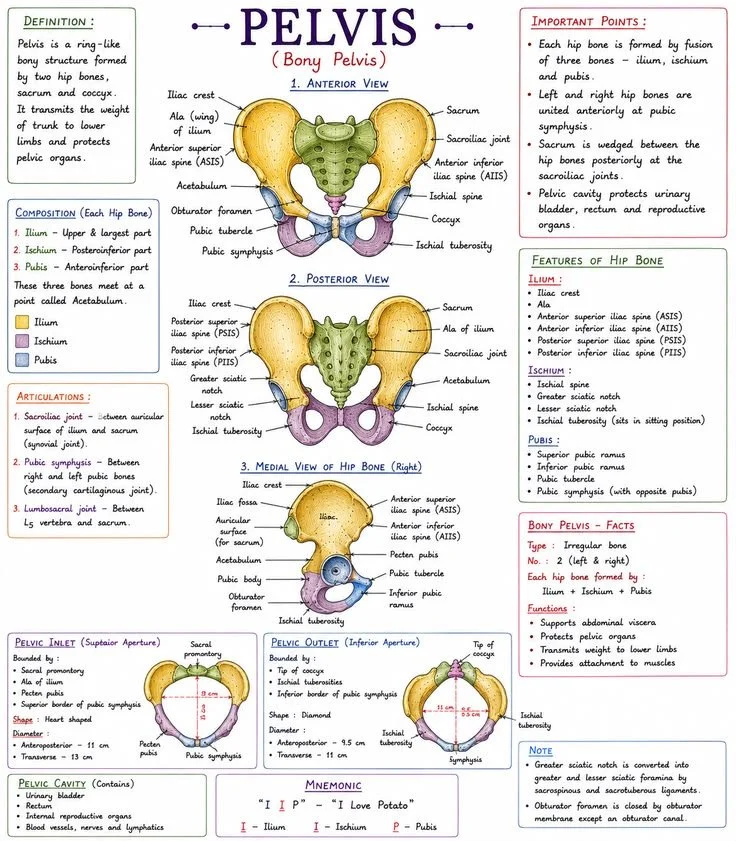
The Pelvis: The Framework of the Birth Canal
Lesson Introduction
The pelvis supports the trunk, connects the spine to the legs, protects pelvic organs, and provides attachment points for muscles and ligaments. It also forms the bony framework of the birth passage.
The pelvis is not a straight, rigid tunnel. It has different regions and dimensions, and its joints allow limited movement. During birth, the pelvis works together with the pelvic floor, other soft tissues, uterine contractions, and the baby's position and movement.
Tips & Tricks
Learn the pelvis in three views.
Front view: notice the pubic symphysis and the two hip bones.
Side view: notice the curve of the sacrum and the relationship between the inlet and outlet.
Top view: imagine looking down through the pelvic inlet.
Remember the three levels of the birth passage.
Inlet: the upper entrance to the true pelvis.
Midpelvis: the middle passage, where the ischial spines are important landmarks.
Outlet: the lower opening of the true pelvis.
Use a simple mental map. The pubic symphysis is at the front; the sacrum and coccyx are toward the back.
Practice explaining the anatomy without predicting the outcome. Understanding the pelvis helps explain birth mechanics, but it cannot tell a doula how an individual birth will progress.
Common Misconceptions
The traditional pelvic shape categories are not a reliable way to predict an individual birth outcome.
The pelvis is not a fixed, straight passage.
One labor position does not universally create more space in every part of the pelvis.
A doula does not diagnose pelvic adequacy.
Recommended Study Links
Knowledge Check
Which bones form the bony pelvis?
What separates the false pelvis from the true pelvis?
What are the three levels of the birth passage?
Why is pelvic shape alone not a reliable birth prediction?
How can a doula use this knowledge appropriately?